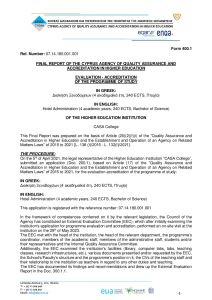
BSc Hotel Administration
| Programme | BSc Hotel Administration |
|---|---|
| Awarded Qualification | Bachelor of Science |
| Duration | 4 Academic Years (8 Semesters) |
| Study Mode | Full-time |
| Language of Instruction | English |
| ECTS | 240 |
| Tuition | €5000 |
Overview
The Hotel Administration programme is designed to provide students with comprehensive knowledge and a deep understanding of the hotel industry. It equips learners with a strong foundation in industry standards, operational practices, and managerial principles. The programme’s primary objective is to deliver high-quality tertiary education by developing the knowledge, skills, and competencies required for successful careers as managers and leaders within the hotel sector. As such, the programme responds directly to the educational needs of the hospitality industry and supports long-term professional career development.
Aim
The Hotel Administration programme aims to equip students with the knowledge, skills, and professional competencies required for successful careers in the hospitality industry. The specific objectives of the programme are to:
- broaden students’ knowledge and practical skills relevant to the operations, functions, and roles across diverse hospitality sectors;
- develop the expertise and leadership capabilities required for supervisory and managerial positions within the hospitality industry;
- nurture graduates who are able to realise their full potential and achieve professional success in the hotel sector;
- familiarise students with the social, economic, and environmental contexts in which the hospitality industry operates;
- support students’ future academic and professional aspirations, whether through further studies or employment within their home countries or across the European Union;
- enhance students’ problem-solving, decision-making, communication, analytical, organisational, and managerial skills;
- provide meaningful opportunities for experiential learning through hands-on training in professional facilities at the College, as well as structured internships with industry partners, ensuring students gain valuable real-world experience.
Learning Outcomes
Upon successful completion of the Hotel Administration programme, graduates will have acquired the knowledge, skills, and professional competencies required to pursue leadership roles and sustainable careers within the hospitality industry. Students will have developed a strong theoretical foundation across key areas of management, research and evaluation, critical thinking, and problem-solving. In addition, they will have gained substantial practical experience through hands-on training in professionally equipped kitchens and restaurant facilities, as well as exposure to real working environments within the local hospitality industry.
In accordance with the European Qualifications Framework (EQF), learning outcomes are classified into knowledge, skills, and competences. Based on the learning outcomes of EQF Level 6 (Bachelor’s Degree), graduates of the programme will be able to:
1. Knowledge
- demonstrate comprehensive and in-depth knowledge of the hospitality and hotel management field;
- analyse contemporary theories, principles, and practices relevant to hotel and hospitality management;
- evaluate the role and interrelationship of hospitality organisations at both national and international levels;
- assess current and emerging issues and trends within the hospitality industry, including sustainability and innovation.
2. Skills
- identify and respond to the demands of a rapidly changing hospitality environment through innovative and evidence-based management approaches;
- analyse customer characteristics and expectations, demonstrating sensitivity to diverse customer needs and behaviours;
- apply theoretical concepts, specialised technical knowledge, and interpersonal skills effectively through supervised work experience and industry placements;
- employ sustainable strategic and operational management techniques in hospitality settings;
- practise effective supervisory, organisational, and resource-management skills;
- demonstrate core operational and managerial skills in hotel and restaurant management, including cost control, food production, hotel operations, legal and regulatory frameworks, event management, and human resource practices;
- apply quantitative reasoning, critical thinking, and problem-solving skills individually and collaboratively.
3. Competences
- operate effectively and responsibly within both local and European hospitality environments characterised by competition and continuous change;
- communicate effectively and develop long-term professional relationships that contribute to both personal development and broader social benefit;
- foster and maintain a positive working environment that encourages teamwork, creativity, and professional ethics;
- manage organisational resources efficiently in order to meet and exceed customer expectations;
- demonstrate autonomy, responsibility, and professional judgement in hospitality management contexts.
Admission Requirements
- The minimum admission requirement for entry to an undergraduate programme of study is the successful completion of a recognised High School Leaving Certificate (HSLC) or an internationally recognised equivalent qualification, with a minimum overall average of 60% and,
- Proof of English Language Proficiency with one of the following approved exams
| Approved Exam | Minimum Grade |
|---|---|
| IELTS | 5 |
| TOEFL IBT | 71 |
| Password Skills Plus Test | 5.5 |
| Anglia Examinations | Intermediate |
| Michigan Language Assessment | ECCE (52) |
| Cambridge GCE AS Level in English Language | C |
| Cambridge GCE A Levels | D |
| Cambridge IGCE or GCSE English as a First Language | E |
| Cambridge IGCE or GCSE English as a Second Language | D |
| University of Cambridge Exams | B2 First (FCE) |
| PEARSON PTE Academic | 58 |
| SAT Evidence-Based Reading and Writing (EBRW): | 530 |
| Common European Framework of Reference Languages (CEFR): | B1 |
| IB English A: Literature SL & HL | 4 |
| IB English B: High Level (HL) | 4 |
| IB English B Standard Level (SL) | 5 |
How to Apply
1. Complete and submit the online Application Form
Make sure you upload the following before submitting:
- Scanned copy of the student’s passport
- High school transcripts showing a minimum 60% overall result
- Proof of English Language Proficiency Test
2. Once the required documents are received, the Admissions & Enrolment Office will review the application. If the application is approved, a Conditional Offer Letter and Proforma Invoice will be issued and sent to the applicant by email.
For international applicants the following documents are required.
| Required Documents | Hague Agreement * | Remaining Countries |
|---|---|---|
| Passport Copy | Apostille | – Valid for a minimum 2 years – Ministry of Foreign Affairs (or Notary Public for Pakistan) – Embassy or Consulate of Cyprus |
| School Certificates | Apostille | – Formal English Translation – Ministry of Foreign Affairs – Embassy or Consulate of Cyprus |
|
Police Clearance Certificate Must be valid for at least 1 month after arrival in Cyprus to open a bank account and complete migration.
|
Apostille | – Valid for a maximum of 6 months – Formal English Translation – Ministry of Foreign Affairs – Embassy or Consulate of Cyprus |
|
Bank Certificate Accompanied by certified statement with minimum balance of 8000€.
|
Apostille | – Valid for a maximum of 6 months – Formal English Translation – Notary Public – Ministry of Foreign Affairs – Embassy or Consulate of Cyprus |
|
Medical Certificates HIV, Hepatitis B&C, VDRL, Chest X-Ray
|
Apostille | – Valid for a maximum of 4 months – Formal English Translation (State Hospital/MOH) – Embassy or Consulate of Cyprus |
Modules
Hospitality Industrial Practical Training (HIPT)
Two (2) ECTS credits are awarded for each Hospitality Industrial Practical Training (HIPT I, II, III). Students are required to successfully complete three (3) practical training placements, each with a minimum duration of three (3) months, for a total of six (6) ECTS credits. The first training placement may be undertaken after the successful completion of the second semester of studies.
Students who do not complete the required Hospitality Industrial Practical Trainings must instead select and successfully pass one (1) module from the General Electives list (6 ECTS).
Assessment & Grading
Student assessment is designed to evaluate both continuous progress and overall academic achievement. Each module is assessed out of a total of 100 marks and consists of the following components:
1. Continuous Assessment (40 marks)
Continuous assessment is carried out during the semester and includes:
- Midterm Examination: 20 marks
- Attendance: 5 marks
- Assignments / Projects (1–3): 15 marks
2. Final Examination (60 marks)
The final written examination takes place at the end of each academic semester and assesses the full content of the module taught during that semester.
Practical Modules
For practical or workshop-based modules, assessment may be based entirely on continuous assessment, with no final written examination. In such cases, the lecturer may assign a special practical exercise or workshop task toward the end of the semester, and the mark awarded will represent the final examination mark.
Final Module Mark
The final mark for each module is calculated as follows:
Continuous Assessment (40 marks) + Final Examination (60 marks) = 100 marks
The minimum passing mark for each module is 50/100.
Marks may be awarded as numerical scores or as grade descriptors, in accordance with the College’s official grading scale.
3. The applicant must then submit the documents listed in the table below electronically to admisisons@casacollege.ac.cy, then send the originals by courier to:
Casa College
3 Zan Moreas Street
1075 Nicosia, Cyprus
| Grading System | Grade Point Average |
Number Mark |
Mark’s Description |
|
A |
4.00 |
93-100 |
Excellent |
|
A- |
3.67 |
90-92 |
Very good |
|
B+ |
3.33 |
87-89 |
Good |
|
B |
3.00 |
83-86 |
Good |
|
B- |
2.67 |
80-82 |
Good |
|
C+ |
2.33 |
77-79 |
Satisfactory |
|
C |
2.00 |
73-76 |
Satisfactory |
|
C- |
1.67 |
70-72 |
Satisfactory |
|
D+ |
1.33 |
67-69 |
Poor |
|
D |
1.00 |
60-66 |
Poor |
|
D- |
0.67 |
50-59 |
Poor |
|
F |
0.00 |
0-49 |
Fail |
|
I |
0.00 |
0 |
Incomplete |
|
W |
0.00 |
0 |
Withdrawal |
|
P |
4.00 |
0 |
Pass |
|
AU |
0.00 |
0 |
Audit |
|
TR |
0.00 |
0 |
Transferred |
Graduation
Students are eligible for graduation once they have completed 240 ECTS Credits
Career Prospects
Graduates of the BSc in Hotel Administration step into a world of exciting global career opportunities across the hospitality and service industries. The programme equips students with the practical skills, managerial knowledge, and industry insight needed for roles in hotels and resorts, luxury hospitality, restaurants, cruise lines, event and conference management, and tourism organisations. Career paths include hotel and operations management, guest relations, food and beverage management, sales and marketing, revenue management, and entrepreneurship. With professional experience, graduates can quickly advance into senior management and leadership roles, building dynamic international careers in one of the world’s most people-focused industries.